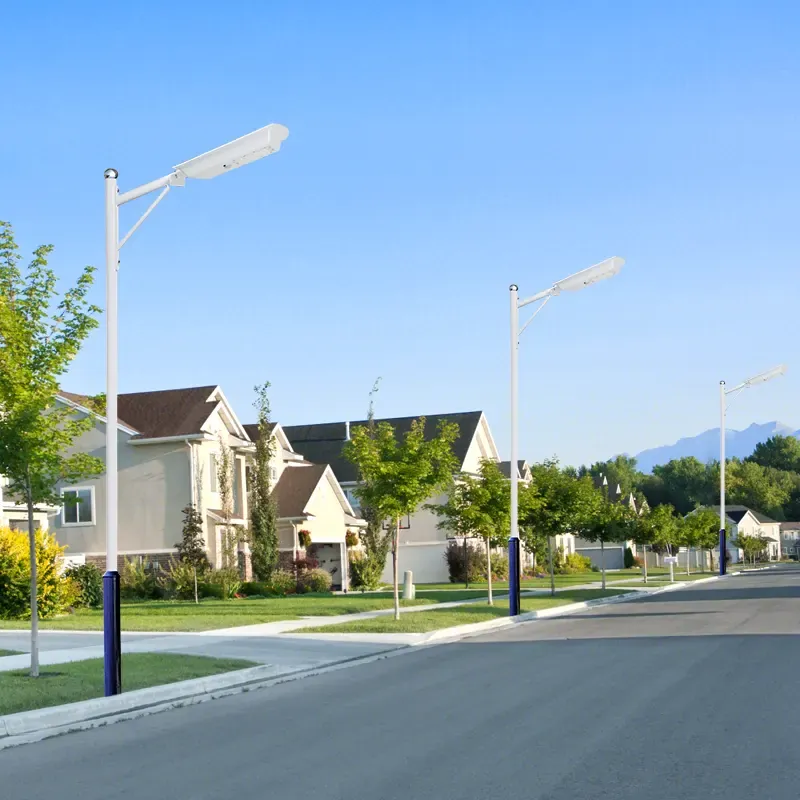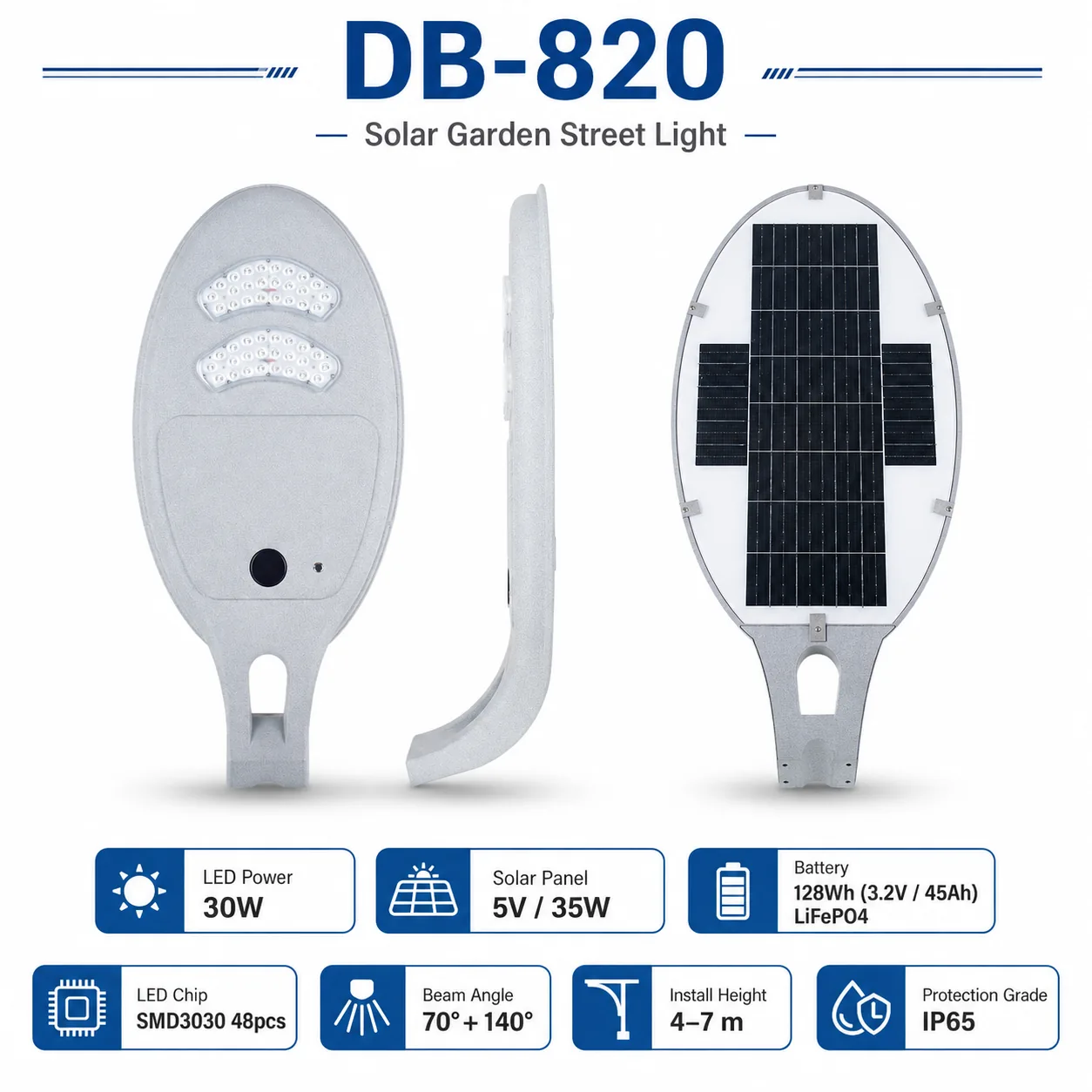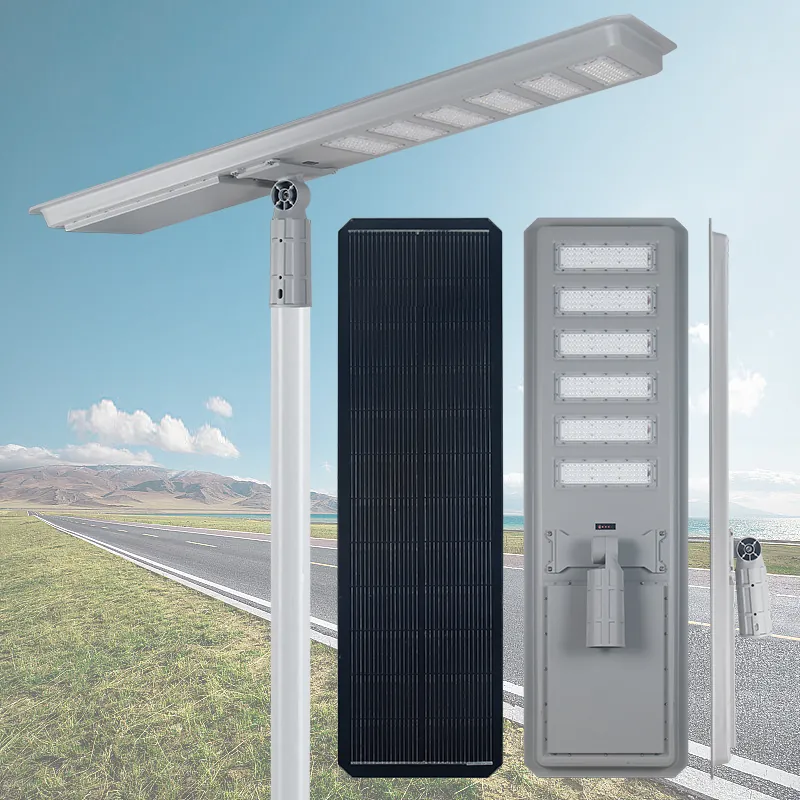

Most solar street light quotes that go wrong go wrong for the same reason: someone picked the wattage based on the road width alone, and ignored three other variables. Then the fixture is either too dim (and the customer complains for 5 years), or massively over-sized (and the customer paid 40% more than they needed to).
This worksheet walks you through every variable that matters, in the order they actually matter, so you can size any project correctly — whether it is a 50-meter residential driveway or a 10-kilometer highway.
The 5 Variables You Need to Know
Before you start calculating, you need five numbers from the project site:
- Road width (meters)
- Pole height (meters)
- Pole spacing (meters)
- Number of consecutive cloudy days in your region (autonomy requirement)
- Mounting location (does the pole get shade from trees or buildings?)
That is it. If you do not have these five, the worksheet will not give you a real number.
Step 1: Wattage from Road Width
This is the most important decision. The light on the ground, not the wattage on the label, is what matters.
The IES (Illuminating Engineering Society) recommendation for road lighting is:
- Residential street: 3-5 lux average, 0.5-1.5 uniformity
- Collector road: 5-8 lux
- Main road: 8-15 lux
- Highway: 15-30 lux
A 170 lm/W LED fixture at 6 meters height will produce approximately these lux levels on a flat road:
| Wattage | 6m pole, 5m road | 8m pole, 7m road | 10m pole, 10m road |
|---|---|---|---|
| 30W | 6 lux (residential) | not enough | not enough |
| 60W | 12 lux (main road) | 8 lux (residential) | not enough |
| 100W | 20 lux (highway) | 13 lux (main road) | 8 lux (residential) |
| 150W | 30 lux (highway+) | 20 lux (highway) | 13 lux (main road) |
| 200W | too much | 27 lux (highway) | 17 lux (main road) |
The right pick depends on your road type, not the wattage that “looks right” in a catalog.
Step 2: Pole Spacing from Road Uniformity
The uniformity ratio (U0) is the ratio between the dimmest point and the brightest point on the road. Anything below 0.4 is unacceptable for driving. The pole spacing that achieves U0 ≥ 0.4 is roughly 3× the pole height for a one-sided layout, or 5× the pole height for a staggered two-sided layout.
| Pole height | 1-sided spacing | 2-sided staggered spacing |
|---|---|---|
| 5m | 15m | 22m |
| 6m | 18m | 25m |
| 7m | 21m | 28m |
| 8m | 24m | 32m |
| 10m | 30m | 40m |
| 12m | 36m | 48m |
If your project has tighter spacing than these numbers, you can drop one wattage tier. If it is wider, you need to step up.
Step 3: Battery Capacity from Autonomy
This is the step most calculators get wrong, because they ignore temperature. A LiFePO4 battery rated at 50Ah at 25°C only delivers about 42Ah at 0°C and 38Ah at -10°C. If you are deploying in a cold region, multiply the calculated capacity by 1.15-1.25.
The formula:
Required capacity (Wh) = LED wattage × night hours × autonomy days × 1.2 (depth of discharge buffer)For a 60W LED, 11-hour nights, 2 days autonomy, moderate climate:
60 × 11 × 2 × 1.2 = 1,584 WhAt 12.8V system voltage: 1,584 / 12.8 = 124 Ah battery
This is a large battery for an all-in-one fixture. Most 60W all-in-ones ship with 30-40Ah batteries, which gives 1 night of real autonomy. To get 2 nights, you typically need to step up to a 80W or 100W fixture with a bigger battery bay, or move to a split system.
Step 4: Solar Panel Wattage from Location
The solar panel must recharge the battery during the day. The formula:
Required solar panel wattage = (Required Wh per day) / (Peak sun hours × 0.85 system derate)Peak sun hours by region (annual average):
- North Africa, Middle East: 5.5-7.0 hours
- Sub-Saharan Africa: 4.5-6.0 hours
- Mediterranean: 4.0-5.5 hours
- South Asia: 4.5-5.5 hours
- Southeast Asia: 3.5-4.5 hours
- Northern Europe: 2.5-3.5 hours
- Pacific Islands: 4.0-5.0 hours
For our 60W LED example, 11-hour night, 1 day autonomy, Sub-Saharan Africa (5 peak sun hours):
Daily consumption: 60 × 11 = 660 Wh
Required panel: 660 / (5 × 0.85) = 155 W
This is why our TR348-C all-in-one ships with an 80W panel — it does not actually meet the 155W spec. It assumes motion-sensor dimming, which reduces average consumption to about 30W, requiring only 80W of panel. If you do not use the motion sensor, you are under-sized for the Sub-Saharan case.
This is also why the standard TR408-A all-in-one is a safer pick for projects with average solar irradiance.
Step 5: Adjust for Shading and Soiling
Real-world conditions knock 10-30% off the panel output:
- Tree shade for 2 hours/day: -15%
- Heavy dust (desert, construction site): -10% (cleaning every 3 months)
- Bird droppings on panel: -5% (cleaning every 6 months)
- Snow cover (winter): -30% (if you do not tilt the panel)
- Coastal salt spray on panel: -3% (rain usually washes it off)
If your site has any of these, multiply the panel wattage by the reciprocal. For a shaded site: 155 × 1.15 = 178W panel minimum.
The Quick-Reference Sizing Table
If all that math is too much, here is the cheat sheet we use internally:
| Road type | Road width | Pole height | Spacing | Wattage | Panel | Battery (1 day) |
|---|---|---|---|---|---|---|
| Residential driveway | 3-4m | 4-5m | 15m | 30W | 40W | 20Ah |
| Residential street | 5-6m | 6m | 18m | 40-60W | 60-80W | 30-40Ah |
| Side road | 6-7m | 7m | 21m | 60W | 80W | 40Ah |
| Main road | 7-9m | 8-9m | 25m | 80-100W | 100-120W | 50-60Ah |
| Highway | 10m+ | 10-12m | 30-35m | 120-150W | 150-180W | 80-100Ah |
| Parking lot (single) | 15m × 30m | 8m | area | 100W flood | 120W | 60Ah |
| Parking lot (array) | per 100 m² | 8m | area | 150W flood | 180W | 80Ah |
This table assumes Sub-Saharan / South Asian / Middle Eastern irradiance (4.5-5.5 peak sun hours), motion sensor dimming, and 1-day autonomy. For different conditions, scale the panel and battery columns.
What If the Math Says You Need 200W?
When the math pushes you above 150W, an all-in-one fixture is usually the wrong answer. The battery and panel sizes get too big to mount on a single pole-arm without structural concerns. Move to a split system: solar panel on a separate ground-mount or roof, battery in a ground box, LED on the pole. The installation is more work, but the engineering is more honest.
For a downloadable Excel version of this worksheet, send us a request and we will email it to you the same day.
Engineering and procurement team at Zhongshan Xiuben Lighting. We design, manufacture, and ship solar street lights, flood lights, and garden lights from our 12,000m² factory to 50+ countries.