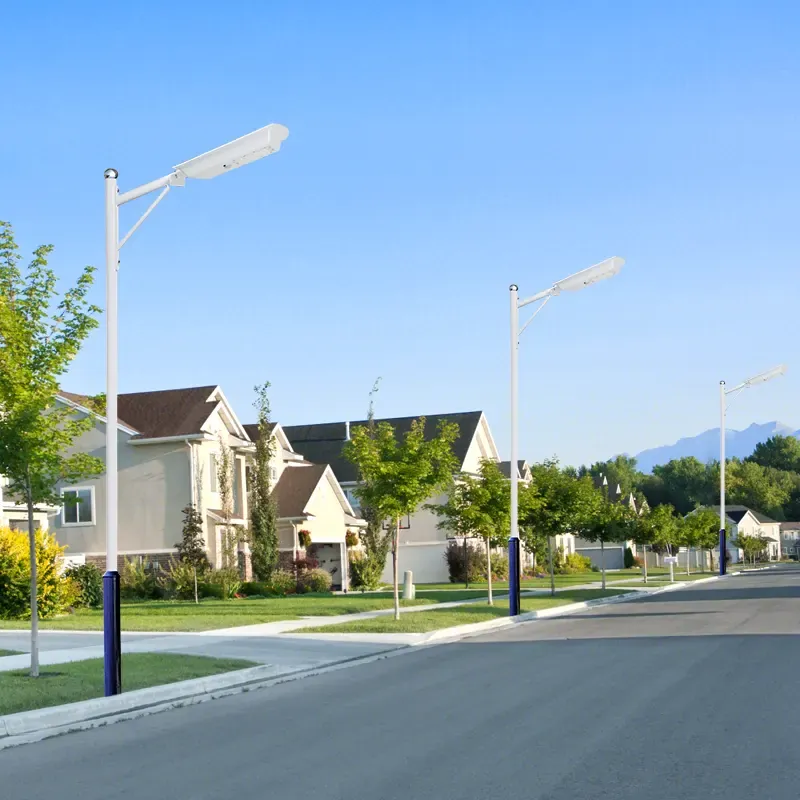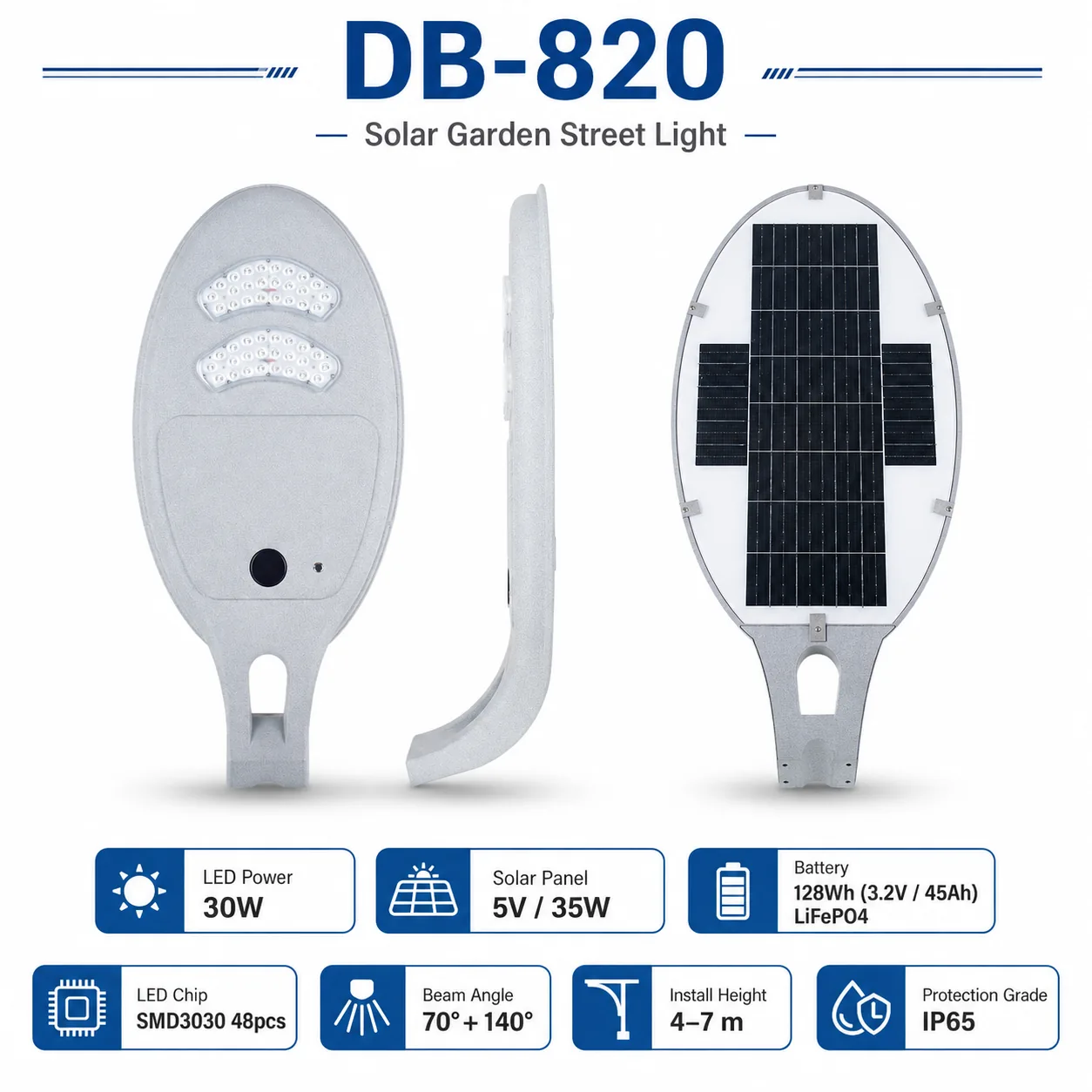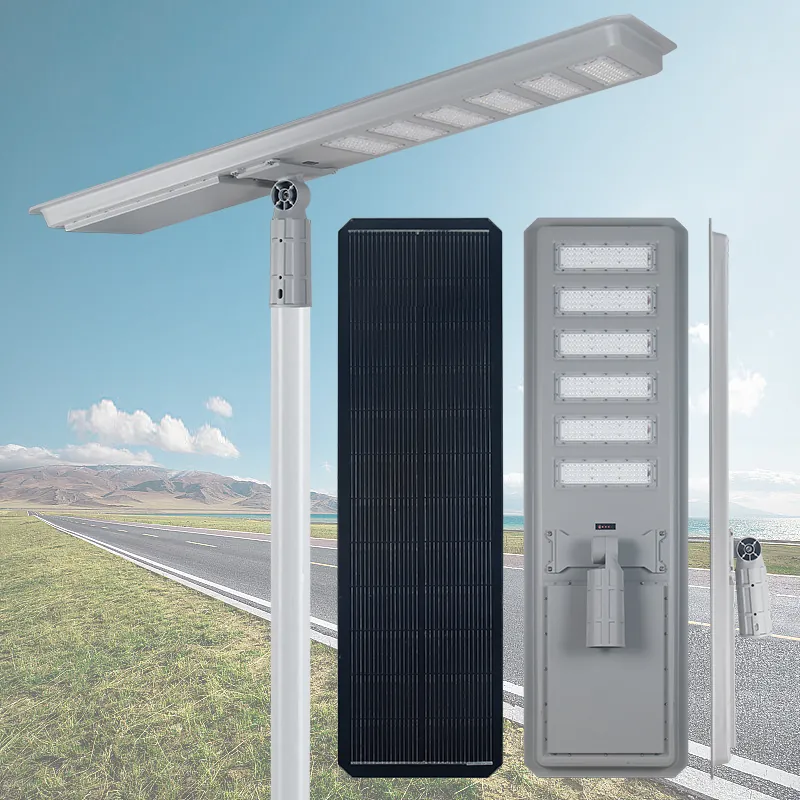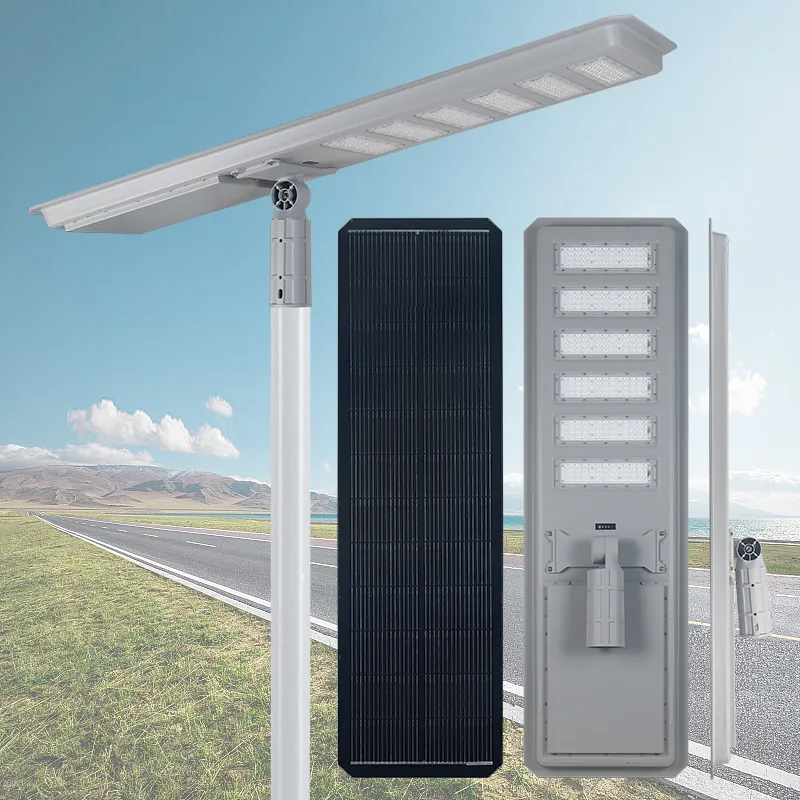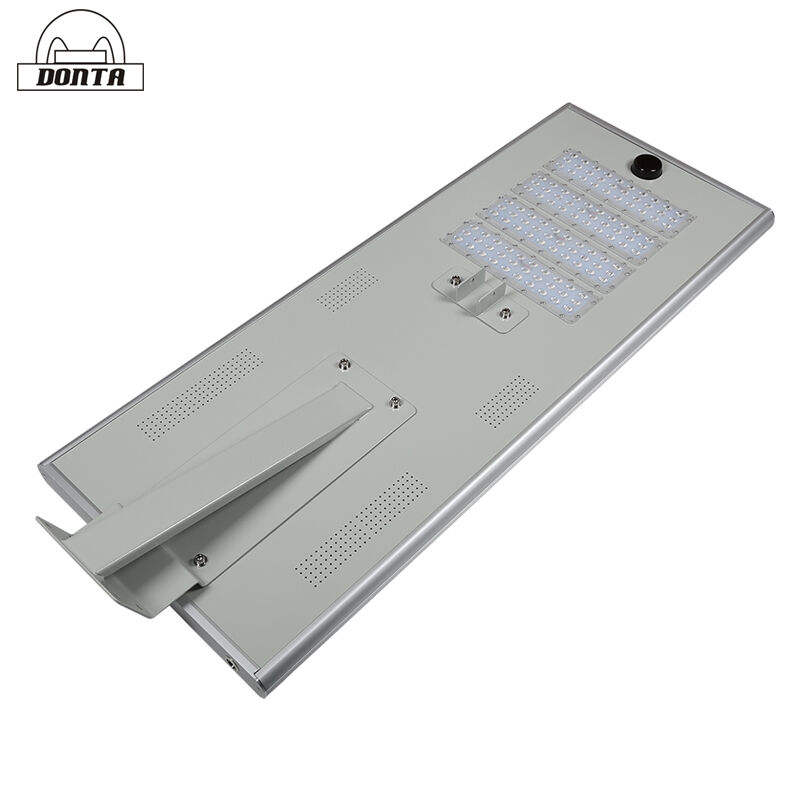

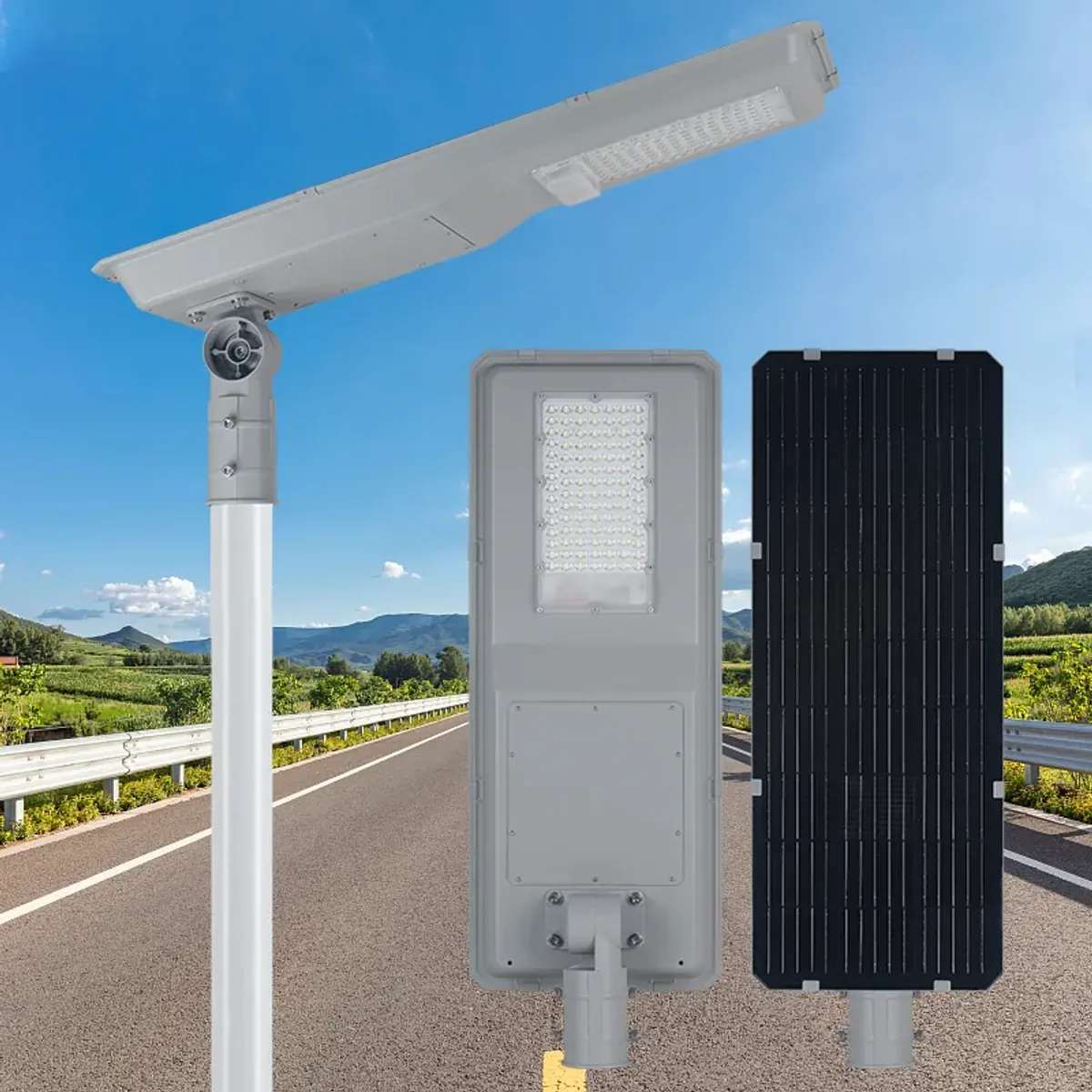
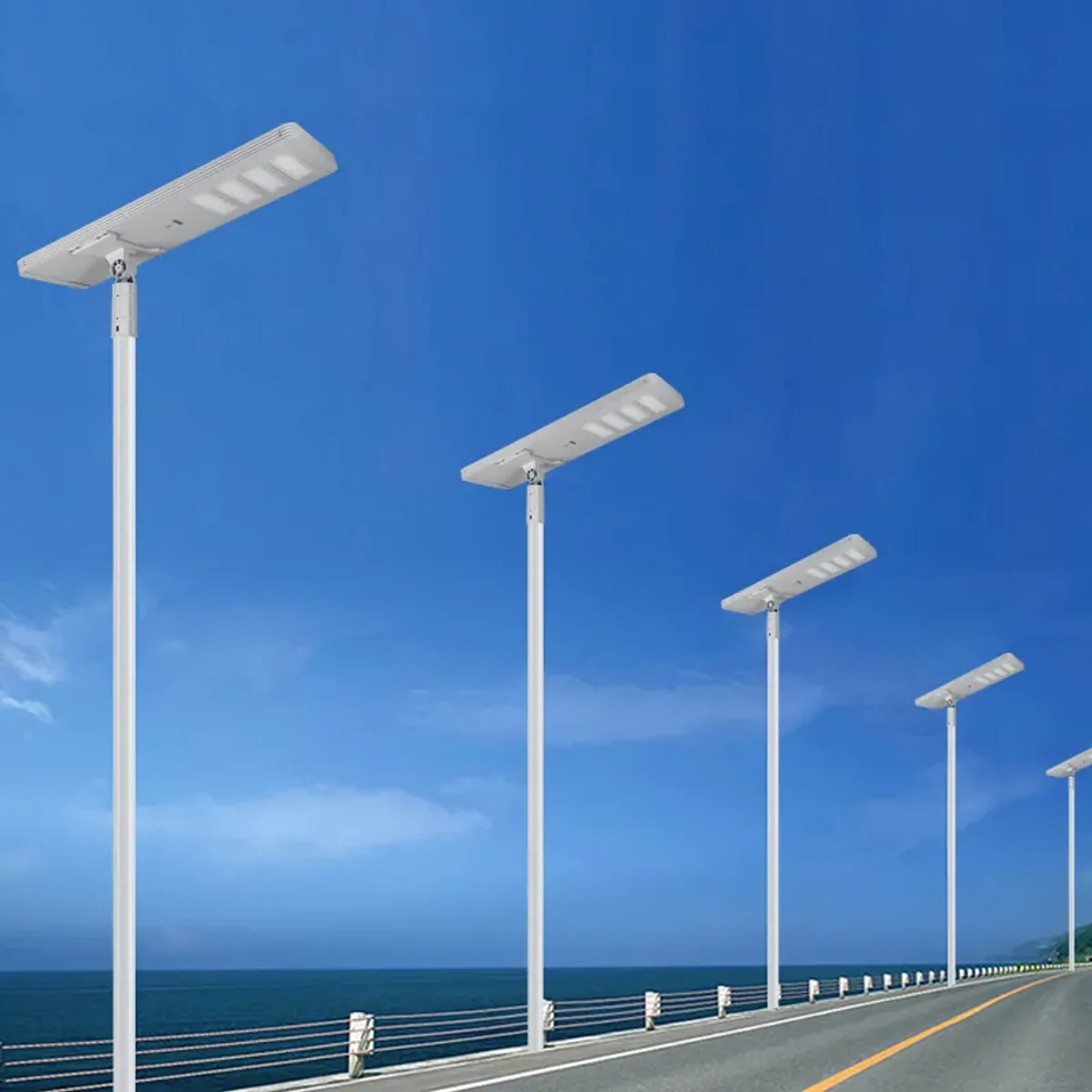
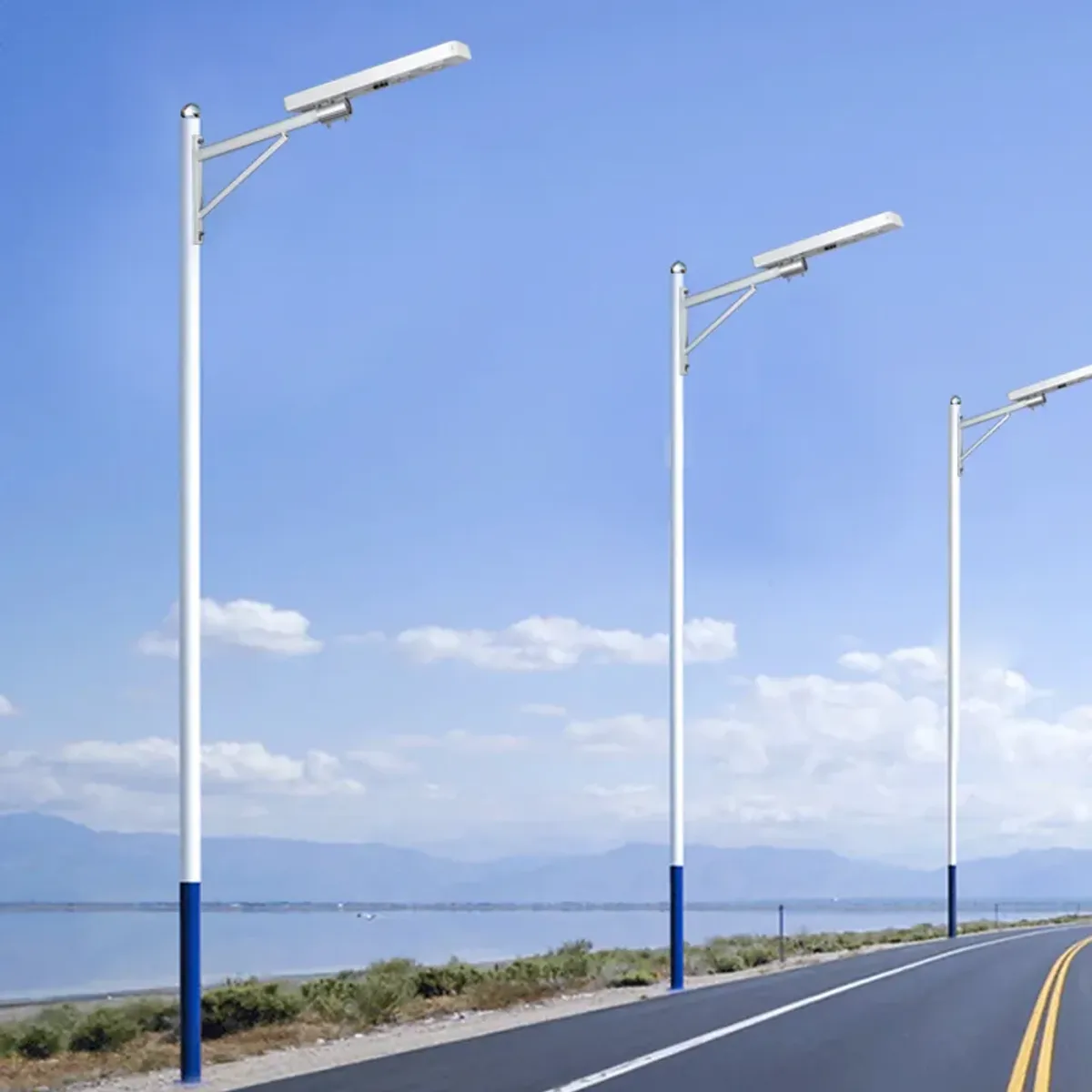
If you are evaluating solar street lights for a road, parking lot, or community project, the all-in-one design is the fastest-growing segment of the market — and for good reason. It packages the solar panel, battery, LED module, and controller into a single fixture you can mount on a pole in under 15 minutes.
But “all-in-one” is a marketing term, not a specification. Two fixtures at the same price can have very different lifespans, light output, and weather resistance. This guide explains what is actually inside an all-in-one solar street light, when to pick it over a split system, and the four technical details that separate a 5-year fixture from an 8-year one.
What “All-in-One” Actually Means
An all-in-one solar street light — sometimes called integrated or “solar street light with built-in battery” — is a single fixture that contains:
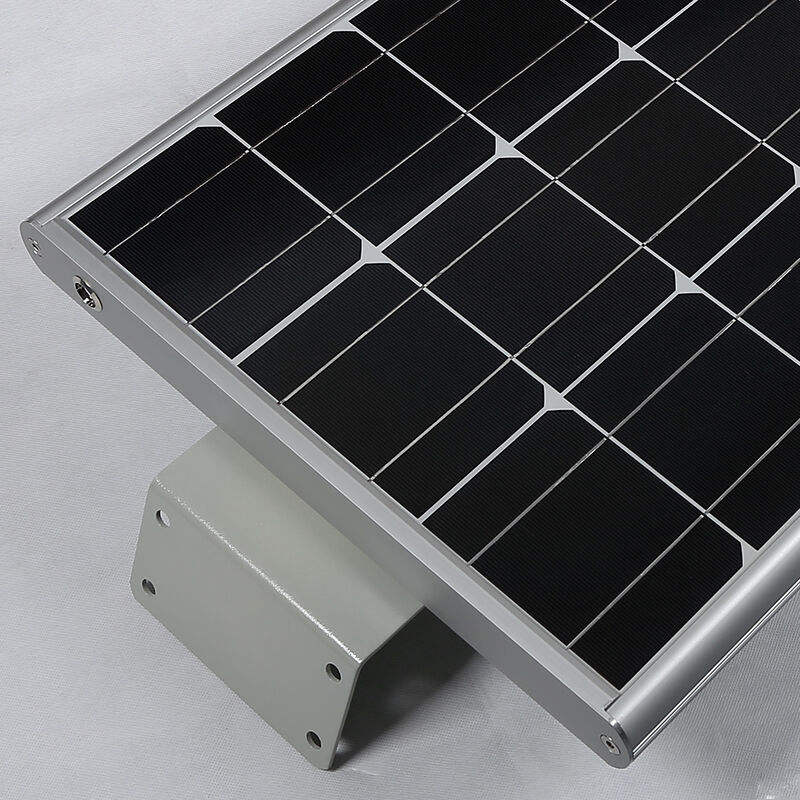
- A mono-crystalline solar panel (usually on the top)
- A lithium iron phosphate (LiFePO4) battery
- An LED module with a Philips or Bridgelux chip
- An MPPT solar charge controller
- A microwave or PIR motion sensor (in most models)
- The aluminum housing and heat sink
The pole, the bracket, and the concrete foundation are not part of the “all-in-one” package. You provide those; the fixture is everything above the tenon bolt.
This packaging matters because it removes three failure points found in split systems: external battery boxes that leak, long DC cable runs that drop voltage, and extra ground-mounting hardware. The trade-off is that the battery is harder to service once it ages, and you cannot easily scale up the solar panel area for high-rainy-season regions.
The 5 Components That Actually Matter
When you compare two all-in-one fixtures at the same wattage, here is where the engineering differences hide.
1. The Battery Chemistry
Most serious suppliers use LiFePO4 (lithium iron phosphate). It offers:
- 2,000–3,000 charge cycles at 80% depth of discharge
- Operating temperature range of -10°C to 60°C
- Thermal runaway risk close to zero (vs. NMC lithium-ion)
A cheap all-in-one might still use a 18650 lithium-ion cell pack. These work in temperate climates but fail quickly above 45°C ambient — which rules out most of the Middle East, North Africa, and tropical Asia. Always ask for the cell datasheet, not just the marketing number.
2. The Solar Panel Wattage
The solar panel area is what determines your rainy-day performance. A 60W LED fixture with a 60W solar panel is under-sized for any region with more than 2 consecutive cloudy days. The rule of thumb is solar panel wattage ≥ 1.5× LED wattage for tropical and sub-tropical regions. For equatorial or rainy areas, 2× is safer.
Our TR348-C all-in-one solar street light ships with an 80W monocrystalline panel for exactly this reason. A 60W panel would under-charge during monsoon season in the Philippines, Indonesia, or West Africa.
3. The MPPT Controller
An MPPT (maximum power point tracking) controller extracts 20–30% more energy from the solar panel than a PWM (pulse-width modulation) controller. On a 80W panel, that is the difference between 320 Wh/day and 400 Wh/day of harvest. If you see a price gap of more than 10% between two fixtures and one of them specifies “PWM”, walk away.
4. The LED Chip and Driver
The brand of the LED chip (Philips Lumileds, Bridgelux, Osram) matters less than the luminous efficacy. Look for ≥170 lm/W. A 60W fixture with 170 lm/W chips produces 10,200 lumens — enough for a 6-meter pole lighting a 6-meter-wide residential road.
The driver (the part that converts battery DC to LED-ready current) should be a constant-current design with surge protection to 6 kV. Anything less will fail within 18 months in regions with frequent lightning.
5. The IP Rating
For outdoor use, you want IP66 as a minimum. IP65 protects against water jets but not against driving rain or prolonged heavy downpours. IP67 is better (temporary submersion) but rarely needed for street lights.
All-in-One vs Split: When to Pick Which
Pick an all-in-one when:
- The project is a road, parking lot, or pathway with at most 2 cloudy days in a row
- The pole is 4–10 meters
- You want fast installation (one person, 15 minutes per pole)
- Spare parts logistics are hard (remote areas, islands)
Pick a split system when:
- The project is in a region with 4+ consecutive cloudy days
- You need 150W or higher LED power
- The pole is 10+ meters (battery in a ground box is easier to service)
- You want to upgrade the LED module in 5 years without replacing the whole fixture
For the 80% of typical B2B projects, all-in-one is the right answer. The split system market is shrinking every year as battery and panel technology improves.
A Buyer’s Checklist (Use This)
Before you place a PO, confirm each of these in writing:
- Battery: LiFePO4, with cycle life and capacity both stated
- Solar panel wattage ≥ 1.5× LED wattage
- Controller: MPPT (not PWM)
- LED efficacy ≥ 170 lm/W
- IP66 housing
- 6 kV surge protection on the driver
- Working temperature range quoted (-10°C to 60°C minimum)
- 3-year full warranty, 5-year LED module warranty
- CE / RoHS / FCC certificates dated within 24 months
- Sample available with a 7–10 day lead time
If your supplier cannot answer any of these in writing, you are looking at a re-seller, not a manufacturer. The price will look 15% cheaper, and the failure rate will be 30% higher in year two.
Our Recommended Starting Point
If you are unsure which model to start with, the TR408-A all-in-one covers most typical road and parking-lot applications. Panel size, battery capacity and output wattage are configurable on the same platform, so one series serves projects of different sizes. For projects in equatorial regions with extended monsoon seasons, the TR348-C is the safer choice because of its larger 80W solar panel.
For a 30-meter pole spacing on a 6-meter-wide residential road, the 60W model is the right starting point. For a 25-meter spacing on a 10-meter main road, step up to the 100W version. For anything above 150W, ask for a split-system quote — all-in-one stops being cost-effective above that wattage.
Request a quote with your road width, pole height, and target country, and we will come back the same day with a Dialux simulation and an FOB Zhongshan price.
Engineering and procurement team at Zhongshan Xiuben Lighting. We design, manufacture, and ship solar street lights, flood lights, and garden lights from our 12,000m² factory to 50+ countries.